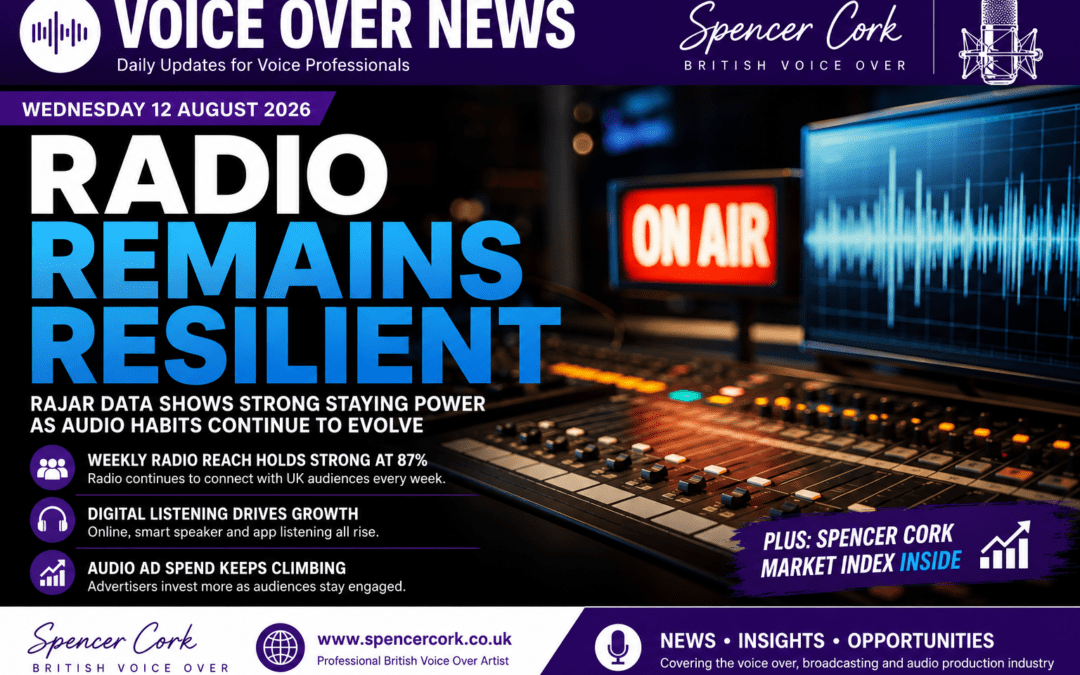
Radio Remains Resilient
Radio's position in the UK media landscape remains remarkably strong, even as audiences gain more ways to consume spoken content.
The latest RAJAR data published for 2026 shows that approximately 87% of the UK population tune into radio each week, while digital platforms account for 77% of radio listening. Digital listening includes DAB, digital television, websites, apps and smart speakers.
That matters because the traditional definition of "radio" is becoming increasingly outdated.
A listener may hear the same broadcaster through a DAB receiver in the morning, a smart speaker at home, an app during the day and a connected car later on.
The distribution has changed.
The demand for audio has not disappeared.
Five Headline Stories
1. Radio Still Reaches the Majority of the UK
RAJAR's latest published 2026 figures show radio continuing to reach around 87% of the UK population each week.
Key takeaway: Radio remains a major mass-reach medium despite competition from streaming and on-demand services.
For voice professionals, this continues to support demand for commercials, continuity, station imaging, promos, sponsorships, documentaries and branded audio.
2. Digital Now Dominates the Way Radio Is Heard
RAJAR reports that digital platforms account for 77% of radio listening, with DAB, smart speakers, websites, apps and connected devices all contributing to the shift.
Key takeaway: Radio is increasingly a digital distribution business rather than simply a broadcast signal.
That expands the potential life of professionally produced voice content.
3. Video Podcasts Are Changing What "Listening" Means
Ofcom's 2026 Audio Report reports that 27% of UK adults listen to podcasts weekly, up from 23% a year earlier. It also found that 68% of weekly podcast listeners listen to podcasts that include video.
Yet audio-only listening remains important: 39% of respondents who consume video podcasts said they prefer listening to them as audio-only content, compared with 27% who prefer watching when video is available.
Key takeaway: Video is expanding podcasting rather than making audio irrelevant.
For producers, that means a single production may need to work simultaneously as audio, video, social content and advertising inventory.
4. Podcast Measurement Is Becoming More Sophisticated
The IAB Tech Lab's Podcast Technical Measurement Guidelines v2.3 are currently open for public comment until 19 August 2026.
The updated framework specifically addresses measurement across both audio and video podcasts distributed through open RSS feeds and podcast applications.
Key takeaway: Podcasting is becoming a more mature advertising medium, with greater emphasis on consistent audience and ad-delivery measurement.
That matters commercially because clearer measurement can make it easier for advertisers and agencies to compare podcast campaigns with other media.
5. Audiobooks Continue to Expand the Professional Audio Market
The audiobook sector continues to attract substantial creative and commercial attention. Recent UK coverage has highlighted the growing investment in high-quality audiobook production, including full casts, sound design and increasingly sophisticated narration.
Today's release schedule also illustrates the continuing volume of professional audiobook production, with multiple new titles released in the UK market and professional narrators credited on the productions.
Key takeaway: Long-form narration remains an important specialist market for professional voice performers.
What This Means for Voice Over
The strongest trend running through today's stories is distribution expansion.
The voice is increasingly required across:
- Radio
- Podcasts
- Video podcasts
- Streaming
- Commercial advertising
- Audiobooks
- Corporate video
- E-learning
- Gaming
- Documentary production
- Social video
- Telephone communications
For organisations requiring professional British Voice Over, this creates a much broader production environment than the traditional radio commercial or television voice over.
You can explore the wider Voice Over Artist UK service for the types of professional voice work being produced across these markets.
Voice Casting Opportunities
Current casting activity continues to demonstrate demand across several different categories.
Backstage's current voice-over roundup includes commercial work such as a Ralph Lauren fragrance campaign alongside animation and other voice opportunities.
The BBC is also currently recruiting across audio production, including a Producer position for BBC Audio Bristol working across readings, arts and factual output for BBC Radio 4, Radio 3, the World Service and BBC Sounds.
A separate BBC Audio North position describes the organisation as producing a wide range of radio and podcast content outside London.
Casting areas worth watching:
- Commercial voice over
- Radio presentation
- Podcast narration
- Documentary narration
- Audiobooks
- Animation
- Gaming
- Corporate narration
- E-learning
- Branded audio
The opportunity is increasingly about versatility, not simply having a recognisable voice.
Business Opportunities
The expansion of audio creates opportunities for businesses that understand how spoken content fits into their wider communications.
Potential applications include:
Podcasting
Corporate podcasts, branded programmes, interviews and thought-leadership content.
Advertising
Radio commercials, podcast advertising, digital audio and social campaigns.
Corporate communications
Narration for presentations, explainers, training and internal communications.
Telephone communications
Professional greetings, IVR prompts, customer-service messaging and Voicemail Recording.
For businesses looking to improve the professional quality of their telephone communications, the dedicated Voicemail & IVR Recording service provides a natural next step.
Industry Trends
Audio is becoming platform-neutral
The same voice recording can increasingly be distributed through radio, podcasts, YouTube, streaming platforms, websites and social media.
Video is becoming part of podcast production
Ofcom's data demonstrates that video has become a significant part of the podcast consumption experience, although many listeners still prefer audio-only consumption.
Digital distribution is now fundamental
RAJAR's 77% digital listening figure demonstrates how far the radio industry has moved away from an exclusively terrestrial model.
Measurement is becoming commercially important
The IAB's updated measurement framework reflects the need for podcast advertising to operate with greater consistency across audio and video.
Technology Watch
Today's technology story is less about AI and more about convergence.
Smart speakers, connected cars, apps, streaming platforms, video podcasting and digital advertising are creating a common distribution ecosystem for spoken content.
Ofcom reports that YouTube, Spotify, BBC Sounds, Amazon Music and Apple Music are among the UK's most-used online audio services.
The production implication is significant:
One recording increasingly needs to work everywhere.
Quality, intelligibility, editing and delivery specifications therefore become increasingly important.
Spencer Cork Market Index
Wednesday 12 August 2026 — Editorial assessment
| Sector | Direction | Outlook |
|---|---|---|
| Radio & Broadcasting | ↑ | Strong |
| Podcasting | ↑ | Strong |
| Audio Advertising | ↑ | Strong |
| Commercial Voice Over | ↑ | Strong |
| Audiobooks | ↑ | Growing |
| Corporate / E-learning | ↑ | Growing |
| Voicemail / IVR | ↑ | Strong |
| Television / Film | → | Stable |
| Gaming / Animation | ↑ | Growing |
| AI Voice Technology | → | Developing |
Market Index note: This is an editorial assessment created for Voice Over News. It is not a financial index or investment recommendation.
Tomorrow's Watch List
- Further UK radio audience developments
- Podcast advertising and measurement
- Video podcast platform announcements
- New voice casting opportunities
- Audiobook releases and production developments
- Digital audio advertising
- Broadcast production recruitment
- Developments in AI voice technology and rights
3. EDITOR'S COMMENT
Radio has survived a remarkable amount of technological change.
The interesting part is that it hasn't done so by standing still.
The radio industry has moved into apps, DAB, smart speakers, connected cars and digital platforms while retaining something remarkably simple: people still want to hear other people communicate.
That is the broader lesson for the voice industry.
Technology changes the delivery mechanism, but good communication remains the product.
For voice artists, producers and businesses commissioning recordings, that creates an increasingly broad marketplace.
The opportunity isn't necessarily to choose between radio, podcasting, video or digital.
It is to understand how the same professional voice can work across all of them.
— Spencer Cork
The Voice Over Industry Update
The Voice Over Industry Update is a daily editorial publication from Spencer Cork Voice Over covering news, developments, opportunities and trends across the professional voice, broadcasting, audio production and spoken-communication industries.
The publication focuses primarily on the UK while following significant international developments that may affect voice professionals, broadcasters, production companies, agencies and businesses using spoken audio.