AI Voice Moves Into Public Services as Rights, Research and Real-World Adoption Accelerate
Voice AI is moving beyond experimentation into government, business and content production, while performer rights, authenticity and human oversight become increasingly important.
Voice Over News — Monday 10 August 2026
Today's Industry Update
Voice AI is becoming a practical part of the communications landscape.
The change is visible across several different areas at once: government services are experimenting with generative voice, natural-language telephone systems are already operating in production, businesses are assessing customer-facing voice AI, and the creative industry is developing models that combine human performance with licensed synthetic voices.
At the same time, the regulatory conversation is becoming more serious.
The question is no longer simply whether AI can reproduce a convincing voice. It is increasingly about who controls that voice, how it is licensed, how audiences interact with it and where human performance remains essential.
UK Government Examines Generative Voice AI for Public Services
The UK's Responsible AI Advisory Panel has reviewed Gov Voice, a programme exploring how generative voice AI could support government call centres. The review forms part of wider work around transparency, assurance and how government AI systems are communicated to the public.
This is particularly significant for the professional voice industry because it moves synthetic speech into a public-facing environment where clarity, accessibility and trust matter considerably.
The UK is also already using natural-language IVR in the DVLA contact centre, allowing callers to describe what they need in ordinary speech before being routed to the appropriate service or adviser.
Key takeaway: Public-sector voice technology is moving towards real-world deployment, increasing the importance of clear, trustworthy and accessible spoken communication.
UK and ElevenLabs Cooperation Broadens the Voice AI Conversation
A UK Government memorandum with ElevenLabs covers public-sector AI adoption and accessibility, alongside AI security, talent and upskilling and the creative economy.
The significance extends beyond one company or one technology.
It demonstrates that voice AI is increasingly being treated as part of a wider national AI strategy rather than simply as a tool for generating audio.
For voice professionals, this creates a more complex market. Human recording, AI voice licensing, voice datasets, accessibility and voice-enabled services can increasingly exist within the same production ecosystem.
Key takeaway: Voice is becoming part of mainstream AI infrastructure, creating both competition and new specialist opportunities.
Japan Continues Work on Unauthorised Voice Use and AI Rights
Japan's Ministry of Justice has been examining civil liability arising from the unauthorised use of images and voices.
The ministry's working group began meeting in April and held its fifth meeting on 27 July. The Justice Minister has said the report is being prepared with a target of publication as early as August.
The issue is particularly relevant to voice performers because AI systems can reproduce aspects of vocal identity without requiring the original performer to participate in the resulting production.
That raises questions around consent, publicity rights, licensing and commercial control.
Key takeaway: Voice identity is increasingly being treated as a rights issue, not merely a technical feature of AI.
New Research Highlights a Large Gap Between Consumer and Business Voice AI Adoption
Voices' Amplified 2026 report provides an interesting snapshot of the current market.
The report says 55% of surveyed consumers have already used voice to interact with AI, while only 29% of surveyed companies have deployed customer-facing voice AI. It also reports that 77% of surveyed decision-makers want exclusive AI voice rights.
That gap suggests that consumer familiarity with voice AI may be developing faster than many organisations' willingness or ability to deploy it.
It also reinforces the importance of brand voice.
A business adopting AI voice technology is not simply choosing a speech generator. It is deciding how its organisation should sound.
Key takeaway: Consumer familiarity is increasing, but businesses are still working out how voice AI fits their brand, customer experience and rights strategy.
Human Voice and AI Voice Are Increasingly Being Positioned Together
The launch of Voices for Agencies combines conventional voice-over talent with branded AI voice services within a single offering. The company describes the model as giving agencies access to human performance and AI voice through one talent network and licensing framework.
That is an important signal for the wider market.
The emerging production model may not be about replacing human voice with synthetic voice.
Instead, a project could use human performance where interpretation and emotional connection are important, while licensed synthetic voice is used for high-volume variations, localisation or controlled updates.
Key takeaway: The market is increasingly moving towards a hybrid model in which human and synthetic voice can serve different purposes within the same production strategy.
Voice Casting Opportunities
Current opportunities remain diverse.
Backstage's current voice-over casting roundup includes commercial work, including a Ralph Lauren fragrance campaign, alongside other voice-over opportunities.
A UK-based paid video-game casting call is also seeking performers for roles requiring Mongolian heritage, with recording scheduled in Glasgow during August and September 2026.
MMG Talent is currently listing a UK voice-over opportunity for a video game with a start date of 15 August 2026.
The opportunities demonstrate the breadth of the current market:
- Commercial advertising
- Corporate narration
- eLearning
- Audiobooks
- Video games
- Animation
- Podcasting
- Documentary narration
- Telephone and IVR
- Character performance
Business Opportunities
The continuing expansion of voice technology creates potential opportunities in both conventional and emerging markets.
Areas worth watching include:
- Corporate and training narration
- Customer-service voice systems
- IVR and telephone messaging
- Accessibility
- Audiobooks
- Podcast production
- Multilingual content
- AI voice licensing
- Branded voice development
- Voice datasets and controlled voice projects
- AI-assisted localisation
- Voice-enabled customer experience
The commercial opportunity is strongest where voice provides something beyond simply reading information.
Trust, interpretation, personality, clarity and consistency remain valuable characteristics.
Industry Trends
Human and synthetic production are converging
The industry is increasingly developing workflows in which human performance and AI technology can coexist.
Voice identity is becoming commercially important
The growth of voice cloning is making consent, licensing and usage rights central business considerations.
Public-sector voice applications are increasing
Government services are already experimenting with conversational and natural-language voice interfaces.
Consumer voice interaction is growing
The Voices research indicates substantial consumer familiarity with AI voice interaction.
Multilingual voice production is becoming more accessible
AI-assisted translation and dubbing can expand the potential reach of spoken content, although human linguistic and performance expertise remains important.
Technology Watch
Today's key technologies include:
- Generative voice AI
- Real-time voice agents
- Voice cloning
- AI dubbing
- Multilingual speech
- Voice conversion
- Synthetic voice detection
- Voice authentication
- AI-assisted audiobook production
- Natural-language IVR
OpenAI's 2026 realtime voice developments illustrate the wider direction of travel, with systems designed for realtime reasoning, translation and transcription rather than simple text-to-speech playback.
One particularly important research finding is that current realtime voice systems can still struggle to respond appropriately to emotional characteristics in speech. Research published in June found that tested systems could identify vocal cues such as fear or sarcasm when asked directly but did not consistently incorporate those cues into their decisions.
That matters.
A voice can communicate considerably more than its transcript.
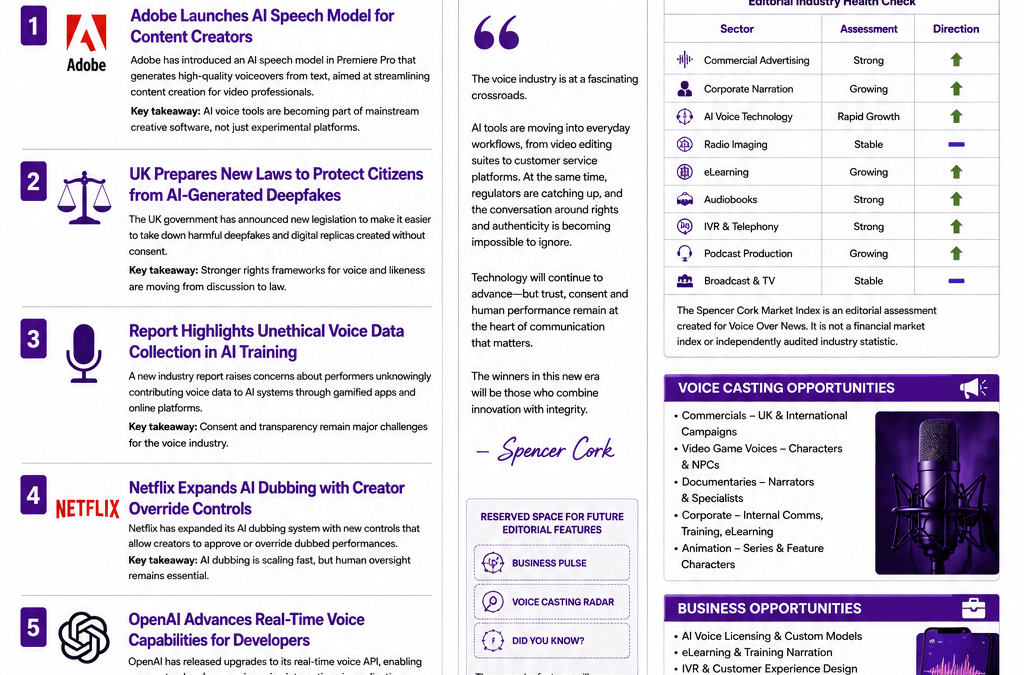
Spencer Cork Market Index
Editorial assessment for Voice Over News — Monday 10 August 2026.
| Sector | Assessment | Direction |
|---|---|---|
| Commercial Advertising | Strong | Improving |
| Corporate Narration | Strong | Improving |
| AI Voice Technology | Rapid Growth | Improving |
| Radio Imaging | Stable | Stable |
| eLearning | Growing | Improving |
| Audiobooks | Strong | Improving |
| IVR & Telephony | Strong | Improving |
| Podcast Production | Growing | Improving |
| Public Sector | Active | Improving |
The Spencer Cork Market Index is an editorial assessment created for Voice Over News. It is not a financial market index or independently audited industry statistic.
Today's Key Takeaways
- Voice AI is moving into practical public-sector applications.
- Consumer use of AI voice is ahead of enterprise deployment.
- Voice cloning is becoming a rights and licensing issue.
- Human and synthetic voice are increasingly being developed as complementary production options.
- Human interpretation, emotion and authenticity remain commercially valuable.
Tomorrow's Watch List
- UK public-sector AI developments
- Voice rights and performer protection
- AI voice licensing
- Realtime voice agents
- AI dubbing and localisation
- Audiobook technology
- New casting opportunities
- Customer-service voice AI
3. Editor's Comment
The industry is moving beyond the human-versus-AI argument
The most useful way to look at the current voice industry is no longer to ask whether AI will replace human voice artists.
The more useful question is where each technology provides the greatest value.
A synthetic voice may be efficient for high-volume updates or multilingual content. A human performer may provide the interpretation, emotion and personality that a brand needs for an important campaign.
At the same time, the growth of voice cloning means performers and clients need to think carefully about consent and licensing before a voice becomes part of an AI workflow.
The voice industry is therefore becoming more sophisticated.
The winning proposition is unlikely to be technology alone.
It will be the right voice, the right performance, the right rights and the right technology for the job.
— Spencer Cork
The Voice Over Industry Update
The Voice Over Industry Update is a daily editorial publication from Spencer Cork Voice Over covering news, developments, opportunities and trends across the professional voice, broadcasting, audio production and spoken-communication industries.
The publication focuses primarily on the UK while following significant international developments that may affect voice professionals, broadcasters, production companies, agencies and businesses using spoken audio.