AI Voice Adoption Accelerates as Authenticity, Rights and Performance Define the Future
The latest developments across UK and international voice technology, casting and audio production show an industry moving rapidly towards AI-assisted communication while questions of human performance, consent and trust become increasingly important.
The Voice Over Industry Update | Edition 003 | Sunday 9 August 2026
Today's Industry Update
The voice industry is entering a new phase.
Artificial intelligence is no longer confined to demonstrations and experimental speech-generation systems. Voice technology is increasingly being considered for public services, customer interaction, content production, multilingual communication and commercial applications.
At the same time, the industry's conversation is becoming more sophisticated.
The question is no longer simply whether AI can produce convincing speech. It is increasingly about where synthetic voice is appropriate, how vocal identity should be protected, what audiences expect from a branded voice and where professional human performance continues to provide something technology cannot easily replicate.
Several developments this week illustrate that shift.
UK Government Continues to Examine Generative Voice AI
The UK Government's Responsible AI Advisory Panel has reviewed Gov Voice, a programme exploring how generative voice AI could support government call centres.
The panel's June summary specifically identifies the project as part of the Government's wider work examining responsible AI adoption, transparency and the experience of people interacting with government services.
This is important for the wider voice industry because it places synthetic speech within a public-service context.
A voice used by a government department is not simply a technical interface. It represents the organisation communicating directly with citizens.
Key takeaway: Public-sector voice AI will need to demonstrate not only technical capability but also clarity, accessibility, reliability and public trust.
AI Is Moving Further Into the UK's Public-Sector Strategy
The Government's wider AI strategy is also developing rapidly.
A new Prime Minister's AI Taskforce, announced in July, has been established to drive the Government's overall AI strategy and accelerate adoption across the public sector.
Although this is broader than voice technology alone, it creates an important environment for voice-based applications.
Government departments are increasingly examining AI as a means of transforming how services are delivered. Spoken interfaces are therefore likely to remain an area worth watching.
Key takeaway: The growth of public-sector AI creates potential opportunities for voice technology, accessibility and human-recorded communications alongside synthetic systems.
Voice Cloning and Performer Rights Remain a Major Industry Issue
The rapid development of voice cloning continues to raise questions about consent, licensing and ownership.
Recent industry discussion has increasingly focused on how voice data is collected and how performers' voices may subsequently be used in AI systems. A recent report examining AI voice-data collection highlights concerns about performers contributing speech data without fully understanding how it may subsequently be used.
Separate legal disputes have also alleged that technology companies used voice recordings or voiceprints in the development of AI systems without appropriate permission.
The underlying issue is becoming increasingly clear: a voice can have commercial and personal identity value beyond the individual recording from which it originated.
Key takeaway: Consent, licensing and permitted usage are becoming fundamental considerations whenever a professional voice enters an AI workflow.
Research Suggests Voice AI Is Becoming a Practical Business Tool
New academic research published in July examined the use of AI voice agents in recruitment.
The natural field experiment involved 70,000 job applicants and compared AI voice-agent interviews with human recruiter interviews. The researchers reported that applicants interviewed by the AI agents were more likely to receive job offers, with the study attributing part of the result to greater structure and consistency in information collection.
The research is particularly interesting because it moves the discussion away from synthetic voice as a novelty.
Here, voice AI is being examined as an operational business system.
That does not mean that AI interviews are necessarily preferable in every situation. It does demonstrate, however, that voice interfaces are increasingly being tested against measurable business outcomes.
Key takeaway: Voice AI is moving from a content-production experiment towards a functional business technology.
Human Voice and AI Voice Are Increasingly Being Offered Together
A recent industry announcement from Voices for Agencies describes a model combining human voice over and branded AI voice services within a single creative offering.
The significance is less about one particular provider and more about the production model it represents.
Instead of treating human recording and synthetic voice as completely separate markets, some organisations are beginning to combine them according to the requirements of a project.
A campaign might require a human performance for its primary advertising film while using a licensed synthetic voice for high-volume variations, updates or personalised content.
Key takeaway: The emerging market may be less about choosing between human and synthetic voice and more about deciding where each is appropriate.
AI Dubbing and Multilingual Production Continue to Develop
AI-assisted dubbing and speech translation remain one of the fastest-moving areas of voice technology.
The technology is becoming increasingly capable of transferring spoken content between languages while attempting to preserve timing, vocal characteristics and expressive qualities.
Research into AI dubbing is also continuing to focus on improving naturalness, speaker identity and synchronisation.
For international brands and content producers, the commercial attraction is obvious.
However, localisation is not simply a translation problem.
Accent, cultural interpretation, performance intention and audience expectations remain important.
Key takeaway: AI may make multilingual production faster, but human linguistic and performance expertise remains important to making translated content sound natural and appropriate.
Voice Casting Opportunities
The current casting market continues to span advertising, documentary, animation, gaming, podcasting and commercial content.
A recent Backstage casting roundup includes voice opportunities connected with projects ranging from a Ralph Lauren fragrance campaign to documentary work.
UK-based performers can also find London voice-over opportunities through established casting platforms, including work involving podcast and presenter roles.
A recently published UK casting call for a paid video-game voice-over project was seeking UK-based performers for roles recording in Glasgow during August and September 2026.
The practical lesson is that opportunities remain diverse.
Commercial work, games, podcasts, animation, corporate content and emerging AI-related projects can require very different performance skills.
Business Opportunities
The growing use of spoken communication across digital services creates opportunities beyond traditional advertising and broadcasting.
Potential demand includes:
- Corporate films
- Training and eLearning
- Customer-service systems
- Public information
- Accessibility
- Telephone and IVR systems
- Product demonstrations
- Podcasts
- Audiobooks
- Digital advertising
- Multilingual communications
- AI voice licensing
- Voice datasets and controlled synthetic-voice projects
The strongest commercial opportunities may increasingly occur where a business needs clarity, trust, personality or brand identity, rather than simply converting written words into audio.
Industry Trends
Human and AI production are converging
The distinction between a traditional voice recording and an AI-enabled voice workflow is becoming less rigid.
Human performers can provide the original performance, direction and vocal identity while technology can potentially extend how that performance is used.
Voice identity is becoming commercially significant
The continuing debate around voice cloning demonstrates that the value of a voice extends beyond a single recording.
Licensing, consent and usage terms are becoming increasingly relevant.
Voice interfaces are expanding
AI voice agents are moving into practical business applications, including customer interaction and information gathering.
Multilingual voice production is becoming more accessible
AI-assisted dubbing and translation could allow organisations to distribute spoken content internationally at a scale that would previously have required much larger production teams.
Authenticity remains important
As synthetic voices become more convincing, the question of authenticity becomes more—not less—relevant.
A technically convincing voice is not necessarily the right voice for a brand.
Technology Watch
Today's areas to watch include:
Generative voice AI
Voice cloning
AI dubbing
Multilingual speech generation
Real-time voice agents
Voice conversion
AI-assisted audiobook production
Customer-service voice AI
Synthetic voice detection
Voice authentication
One particularly important development is the movement towards real-time conversational voice AI.
Research into enterprise voice agents is increasingly concentrating on latency, streaming speech recognition, language-model processing and text-to-speech systems working together in real time.
That suggests the next major development may not simply be better-sounding generated voices.
It may be the ability for organisations to have genuinely conversational voice systems operating at scale.
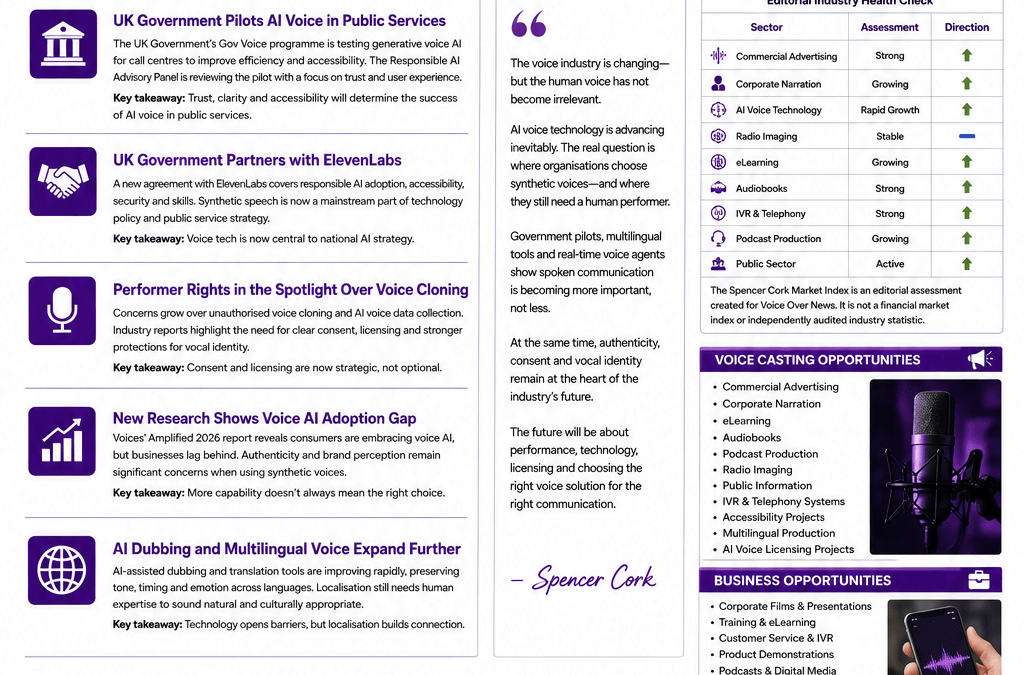
Spencer Cork Market Index
Editorial Industry Health Check
| Sector | Current Assessment | Direction |
|---|---|---|
| Commercial Advertising | Strong | Improving |
| Corporate Narration | Growing | Improving |
| AI Voice Technology | Rapid Growth | Improving |
| Radio Imaging | Stable | Stable |
| eLearning | Growing | Improving |
| Audiobooks | Strong | Improving |
| IVR & Telephony | Strong | Improving |
| Podcast Production | Growing | Improving |
| Public Sector | Active | Improving |
The Spencer Cork Market Index is an editorial assessment created for The Voice Over Industry Update. It is not a financial market index or independently audited industry statistic.
Editor's Comment
The voice industry is changing—but the human voice has not become irrelevant
The most interesting development is not that AI voice technology is advancing. That was inevitable.
The more important question is where organisations decide that synthetic voice is appropriate—and where they still need a human performer.
Government experimentation, commercial voice AI, real-time voice agents and multilingual production all demonstrate that spoken communication is becoming more important, not less.
At the same time, the continuing debate around voice cloning demonstrates that people still care about who is speaking, how their voice is being used and whether that use has been authorised.
The future is therefore unlikely to be simply human versus AI.
It is more likely to be about performance, technology, licensing and choosing the right voice solution for the right communication.
— Spencer Cork
Tomorrow's Watch List
The next edition will continue following:
- UK developments around responsible AI
- Government voice and accessibility projects
- Voice cloning and performer rights
- AI dubbing and localisation
- Real-time voice agents
- Audiobook technology
- Customer-service voice AI
- New professional voice casting opportunities
The Voice Over Industry Update
The Voice Over Industry Update is a daily editorial publication from Spencer Cork Voice Over covering news, developments, opportunities and trends across the professional voice, broadcasting, audio production and spoken-communication industries.
The publication focuses primarily on the UK while following significant international developments that may affect voice professionals, broadcasters, production companies, agencies and businesses using spoken audio.