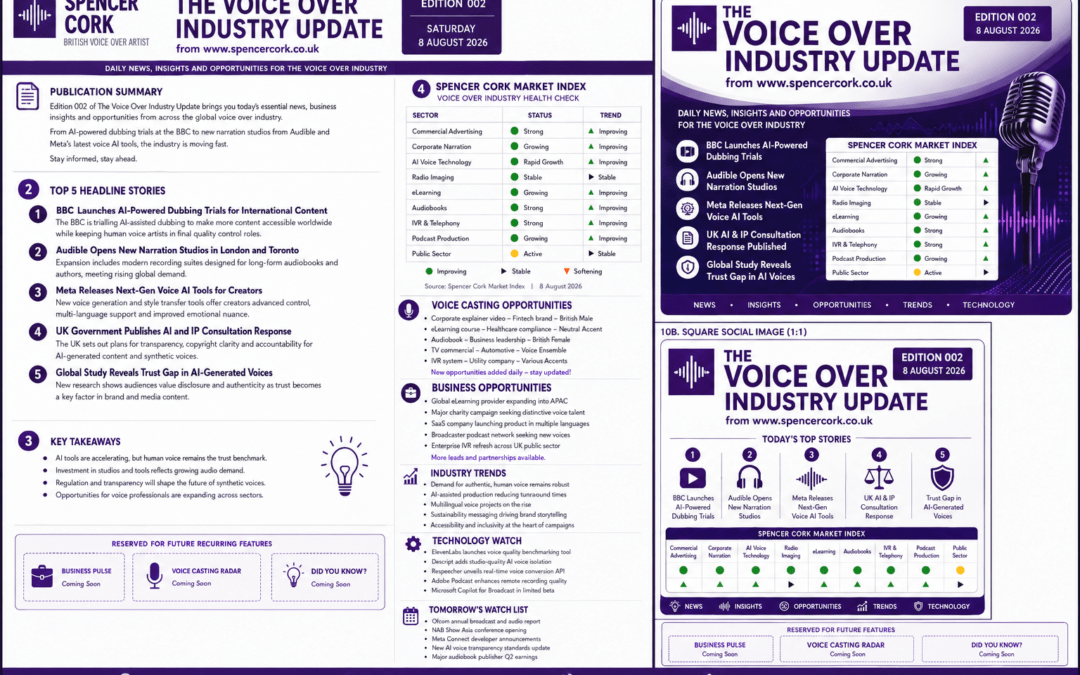
THE VOICE OVER INDUSTRY UPDATE
Edition 002 | Saturday 8 August 2026
Voice AI Moves Into the Mainstream as Human Performance, Trust and Voice Rights Take Centre Stage
The latest developments across voice technology, broadcasting, casting and professional audio reveal an industry increasingly shaped by the relationship between artificial intelligence and authentic human performance.
Today's Industry Update
The professional voice industry is entering a significant period of change.
Artificial intelligence is moving rapidly from experimental technology into practical applications across customer service, accessibility, content creation, translation and public services.
At the same time, performers, businesses and regulators are increasingly addressing the questions that accompany that development: Who owns a voice? When should AI be used? How should audiences know when they are hearing a synthetic voice? And where does human performance remain commercially important?
Today's developments provide several interesting indicators of where the industry may be heading.
UK Government Explores New Applications for Voice AI
The UK Government has been examining the potential use of generative voice AI through its Gov Voice programme, which explores how the technology could potentially support government call centres.
The Government's Responsible AI Advisory Panel has considered the programme in the context of efficiency, public trust and the experience of people using government services.
This is significant because voice AI is no longer being considered solely as a content-production technology.
It is increasingly being examined as a potential interface between organisations and the public.
Key takeaway: The success of voice AI in public services will depend on more than technical capability. Trust, accessibility, reliability and the quality of the interaction will be equally important.
UK Government and ElevenLabs Examine Responsible AI Opportunities
The UK Government has also established cooperation with ElevenLabs covering areas including public-sector AI adoption, accessibility, AI security, talent and skills.
The agreement illustrates how rapidly synthetic speech is moving into mainstream discussions around technology policy and public services.
For the professional voice industry, this creates an interesting distinction.
The technology may be synthetic, but the questions surrounding its use are fundamentally human: identity, communication, accessibility, trust and responsibility.
Key takeaway: Voice technology is becoming part of wider AI policy rather than remaining solely an audio-production issue.
Voice Cloning Raises New Questions About Performer Rights
Concerns about unauthorised voice cloning continue to emerge internationally.
Japanese voice actor Megumi Ogata has spoken publicly about the use of AI to reproduce performers' voices without appropriate authorisation.
The issue highlights a growing challenge for the industry.
A professional voice is not simply an audio file. It can become part of a performer's identity and commercial reputation.
As synthetic voice technology becomes more convincing, questions surrounding consent, licensing and permitted usage are likely to become increasingly important.
Key takeaway: Voice licensing and performer consent are becoming strategic issues rather than technical footnotes.
New Research Highlights the Growing Use of Voice AI
Research published in Voices' Amplified 2026 report indicates that consumers are increasingly interacting with AI through voice.
The research also identifies a significant gap between consumer adoption and business deployment of customer-facing voice AI.
Perhaps more importantly for professional performers, the report highlights concerns about authenticity and brand perception when businesses use synthetic voices.
This suggests that the commercial question may not simply be whether a company can use AI-generated speech.
It is whether doing so produces the right experience for its customers.
Key takeaway: Greater technological capability does not automatically mean that synthetic voice is the right choice for every brand.
Multilingual Voice Technology Continues to Expand
AI-assisted translation and dubbing are also becoming increasingly sophisticated.
Technology companies are developing systems capable of translating spoken content while attempting to preserve characteristics of the original speaker.
This could significantly reduce the barriers involved in producing international content.
For businesses, creators and broadcasters, the potential is considerable.
For professional voice artists, however, it also introduces new questions about localisation, performance direction, licensing and the role of native-language performers.
Key takeaway: International voice production is becoming more accessible, but effective localisation remains more complex than simply translating words.
Voice Casting Opportunities
The developments being seen across the industry continue to create potential opportunities for professional performers in areas including:
- Commercial advertising
- Corporate narration
- eLearning
- Audiobooks
- Podcast production
- Radio imaging
- Public information
- Telephone and IVR systems
- Accessibility projects
- Multilingual production
- AI voice licensing and controlled synthetic voice projects
The emerging AI market may also create opportunities for performers whose voices are licensed specifically for controlled technological applications.
Business Opportunities
Businesses continue to require professional spoken communication for an increasingly broad range of applications.
These include:
- Product demonstrations
- Corporate films
- Training programmes
- Customer onboarding
- Public information
- Advertising campaigns
- Website video
- Telephone systems
- Accessibility content
- Internal communications
The strongest opportunities are likely to remain where communication requires trust, interpretation, personality or emotional connection.
Industry Trends
Human and AI production are increasingly converging
The industry is moving towards production models in which artificial intelligence can assist with efficiency while human performers remain central to projects requiring interpretation, direction and authentic communication.
The voice is becoming a recognised commercial asset
The growth of voice cloning is forcing businesses and performers to think more carefully about licensing, consent and identity.
Voice interfaces are expanding
Voice is becoming increasingly important as an interface for AI systems and customer services.
Multilingual production is becoming more accessible
AI-assisted translation and dubbing are making international content easier to produce, although effective localisation still requires careful attention to language, culture and performance.
Authenticity remains commercially relevant
As synthetic voices become more convincing, audiences may become more—not less—interested in whether the voice they are hearing is authentic.
Technology Watch
Today's areas to watch include:
Generative voice AI
Voice cloning
AI dubbing
Multilingual speech generation
Real-time voice interaction
Voice conversion
AI-assisted audiobook production
Customer-service voice AI
Voice authentication
Synthetic voice detection
Spencer Cork Market Index
Editorial Industry Health Check
| Sector | Current Assessment | Direction |
|---|---|---|
| Commercial Advertising | Strong | Improving |
| Corporate Narration | Growing | Improving |
| AI Voice Technology | Rapid Growth | Improving |
| Radio Imaging | Stable | Stable |
| eLearning | Growing | Improving |
| Audiobooks | Strong | Improving |
| IVR & Telephony | Strong | Improving |
| Podcast Production | Growing | Improving |
| Public Sector | Active | Stable |
The Spencer Cork Market Index is an editorial assessment created for The Voice Over Industry Update. It is not a financial market index or independently audited industry statistic.
Editor's Comment
The voice industry is changing—but the human voice has not become irrelevant
The most interesting development is not that AI voice technology is advancing. That was inevitable.
The more important question is where organisations decide that synthetic voice is appropriate—and where they still need a human performer.
Government experimentation, multilingual voice technology and increasingly sophisticated voice interfaces demonstrate that spoken communication is becoming more important, not less.
At the same time, concerns around unauthorised cloning and authenticity demonstrate that audiences and performers continue to place significant value on the human voice.
The future is therefore unlikely to be simply human versus AI.
It is more likely to be about performance, technology, licensing and choosing the right voice solution for the right communication.
— Spencer Cork
Tomorrow's Watch List
The next edition will continue following:
- UK developments around responsible AI
- Voice cloning and performer rights
- AI dubbing and multilingual production
- Voice technology
- Audiobook production
- Customer-service voice AI
- Opportunities for professional voice talent
The Voice Over Industry Update
The Voice Over Industry Update is a daily editorial publication from Spencer Cork Voice Over covering news, developments, opportunities and trends across the professional voice, broadcasting, audio production and spoken-communication industries.
The publication focuses primarily on the UK while following significant international developments that may affect voice professionals, broadcasters, production companies, agencies and businesses using spoken audio.
The Voice Over Industry Update – Edition 002
AI voice is advancing fast, but authenticity, consent and human performance remain central to the industry's future.
UK Government AI, voice cloning, casting, technology & market trends.
#VoiceOver #VoiceAI #AudioIndustry #AI