spencer cork

Museum Narration: Professional Voice Over for Museums, Exhibitions and Audio Guides
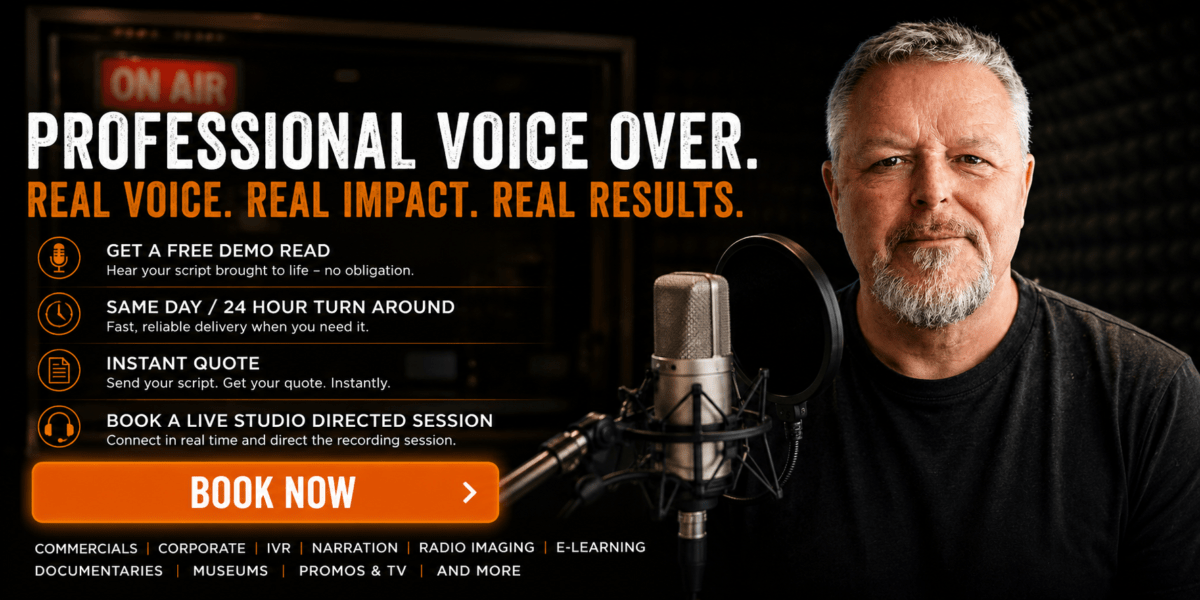
Professional British voice over artist Spencer Cork in a broadcast-quality recording studio with microphone and pop shield, offering free demo reads, instant quotes, same-day turnaround and live directed voice over sessions for commercials, corporate narration, IVR, radio imaging and e-learning projects.

Tell Me About Your Project

✔ Get a Free Demo Read – Absolutely No Obligation  ✔ Fast Response Times – Usually Within the Hour

✔ Same-Day Recording Available – 24-Hour Turnaround Standard

✔ Friendly, Professional Service from First Contact to Final Delivery

✔ Instant Quote – Send Your Script Today

Voice Over Quick Listens

More Samples on Commercial / Corporate / Documentary / Gaming and Characters / Podcast and Radio Pages

Conversational Voice Over

This conversational voice over demo demonstrates a natural, friendly and approachable delivery style. Perfect for explainer videos, online content and brand storytelling, this tone helps connect with your audience in an authentic way. If you need a British voice over artist who sounds real and relatable, this style is ideal for modern digital content.

Corporate Voice Over

This corporate voice over demo is designed for business presentations, company videos and professional communications. With a confident and authoritative tone, it’s ideal for corporate narration, internal training and promotional content. If you’re looking for a UK voice over artist for corporate voice over work, this style delivers clarity and professionalism.

Training and Learning

This is a professional British male voice over designed for e-learning, training courses and instructional content. Clear, engaging and easy to follow, this style is ideal for corporate training, online learning platforms and educational videos. If you’re looking for a reliable UK voice over artist for e-learning narration, this demo showcases a calm and professional delivery.

Radio and Television Commercials

This is a professional British voice over for radio and television commercials. Designed to capture attention and deliver your message clearly, this style works perfectly for advertising campaigns, brand promotions and broadcast media. If you’re looking to hire a UK voice over artist for commercial voice over work, this demo highlights a confident and engaging delivery.

Energetic and Upbeat

This energetic voice over demo showcases a lively, upbeat and engaging style, ideal for promotional videos, advertising campaigns and high-impact content. Perfect for brands that want to stand out, this British voice over delivers energy, clarity and enthusiasm. A great choice if you need a dynamic voice over artist for commercials or online marketing.

Characters and Gaming Voice Overs

A selection of Gaming and Character style voices showcasing a diverse range and ability for vocal delivery in the character and gaming video and onine market.

Movie Trailer and Voice of God VOG

Here is a demo reel for a dramatic cinematic style voice over delivery. Ideal for Movie Trailers and Promos and Voice of God Style VOG presentations or live events.

Narration in a Senior Voice Over Style

This narration is purposely in the style of a more senior person than myself, to showcase a diverse range of delivery styles. This is aimed at the senior 60+ age range.

Radio Station Voice Overs

 Bringing Radio Stations to Life with Radio Station Voice Over Idents, Promo's, Station Name and Presenter Name Drops.

Museum Narration: Professional Voice Over for Museums, Exhibitions and Audio Guides

Museum Narration is professional voice recording created for museums, galleries, exhibitions, heritage organisations, cultural institutions and visitor experiences. Museum narration is used for audio guides, exhibition films, interactive displays, digital interpretation, virtual exhibitions, educational content, historical storytelling and visitor orientation. Effective Museum Narration combines clear communication with engaging storytelling, helping visitors understand objects, events, people, places and ideas without distracting from the exhibition itself. The appropriate delivery may range from measured Documentary Narration and authoritative historical interpretation to conversational storytelling, Emotional Storytelling and accessible Educational Voice.

What Is Museum Narration?

Museum Narration is professional voice recording created specifically to communicate information, stories and interpretation within museum and exhibition environments.

It can be used by:

  • Museums
  • Art galleries
  • Heritage organisations
  • Cultural institutions
  • Historic houses
  • Archaeological sites
  • Science museums
  • Natural history museums
  • Military museums
  • Transport museums
  • Visitor centres
  • Exhibition designers
  • Cultural production companies

Museum Narration can form part of both physical and digital visitor experiences.

The voice may guide visitors through an exhibition, explain an individual object, introduce a historical event or connect multiple exhibits into a wider story.

Why Is Professional Narration Important in Museums?

Museums contain information that can be complex, unfamiliar or highly specialised.

Professional narration can help make this information more accessible.

The voice can support visitors by:

  • Providing historical context
  • Explaining objects
  • Introducing people and events
  • Connecting themes
  • Guiding visitors through exhibitions
  • Communicating specialist information
  • Creating emotional context

The objective is not simply to read exhibition text aloud.

Effective Museum Narration should complement the physical or digital experience and help audiences understand why the subject matters.

Museum Narration for Audio Guides

Audio guides are one of the most established applications of professional Museum Narration.

They allow visitors to explore exhibitions at their own pace.

Professional narration can introduce:

  • Individual objects
  • Artworks
  • Historical events
  • Buildings
  • People
  • Scientific concepts
  • Cultural traditions

Audio guide narration requires careful pacing.

Visitors may be walking, observing an object or navigating between locations while listening.

The performance should give them enough time to process both the audio and their surroundings.

Museum Narration for Exhibitions

Temporary and permanent exhibitions often use audio and video alongside physical displays.

Professional narration can support:

  • Exhibition introductions
  • Thematic films
  • Interactive displays
  • Object interpretation
  • Historical reconstructions
  • Digital installations

The delivery should match the exhibition's subject and audience.

A contemporary art exhibition may require a different approach from a military history exhibition or children's science experience.

Museum Narration for Exhibition Films

Museums frequently use short films to provide context.

These may introduce:

  • Historical periods
  • Important individuals
  • Scientific discoveries
  • Cultural movements
  • Archaeological sites
  • Social history

Professional narration helps connect archive material, interviews, animation and visual storytelling.

Documentary Narration can be particularly appropriate.

Explore Documentary Narration:

https://spencercork.co.uk/documentary-narration/

Museum Narration for Art Galleries

Art galleries may use professional narration for:

  • Audio guides
  • Artist biographies
  • Exhibition introductions
  • Artwork interpretation
  • Curatorial content
  • Digital exhibitions

The voice should provide context without dictating how the visitor should respond to the artwork.

A measured and thoughtful delivery can allow space for personal interpretation.

Museum Narration for History Museums

History museums interpret events that may span centuries.

Professional narration can help explain:

  • Historical periods
  • Political events
  • Social change
  • Everyday life
  • Important individuals
  • Local history

Narrative Voice can connect individual facts into a coherent historical story.

Explore Narrative Voice:

https://spencercork.co.uk/narrative-voice/

Museum Narration for Natural History Museums

Natural history museums communicate subjects including:

  • Evolution
  • Geology
  • Dinosaurs
  • Wildlife
  • Ecosystems
  • Climate
  • The natural world

Professional narration should communicate scientific information accurately while remaining accessible.

Informative Voice can help explain complex concepts clearly.

Explore Informative Voice:

https://spencercork.co.uk/informative-voice/

Museum Narration for Science Museums

Science museums often need to explain complex concepts to broad audiences.

Professional voice over can support:

  • Interactive exhibits
  • Demonstration videos
  • Educational films
  • Digital installations
  • Visitor guides

Explainer Voice can make technical subjects easier to understand without oversimplifying them.

Explore Explainer Voice:

https://spencercork.co.uk/explainer-voice/

Museum Narration for Military Museums

Military museums may cover subjects involving conflict, service and personal experience.

Professional narration can support:

  • Historical interpretation
  • Archive films
  • Personal accounts
  • Equipment displays
  • Campaign histories
  • Memorial exhibitions

The delivery should respect the seriousness of the subject.

Dramatic Voice may sometimes be appropriate, but excessive theatricality can undermine historical credibility.

Museum Narration for Transport Museums

Transport museums may cover:

  • Railways
  • Aviation
  • Maritime history
  • Motor vehicles
  • Industrial transport
  • Public transport

Professional narration can combine technical information with stories about innovation, engineering and social change.

Technical Narration may be appropriate for detailed subject matter.

Explore Technical Narration:

https://spencercork.co.uk/technical-narration/

Museum Narration for Local History Museums

Local museums preserve the stories of communities.

Professional narration can communicate:

  • Local industries
  • Historic events
  • Personal stories
  • Changing communities
  • Local traditions
  • Oral histories

A warm and authentic voice can help create a stronger connection between the visitor and the place.

Explore Authentic Voice:

https://spencercork.co.uk/authentic-voice/

Museum Narration for Heritage Sites

Museum Narration also overlaps with heritage interpretation.

Professional voice over can support:

  • Historic buildings
  • Archaeological sites
  • Castles
  • Industrial heritage
  • Historic landscapes
  • Visitor centres

Narration can help visitors understand what they are seeing and how the site has changed over time.

Museum Narration for Historic Houses

Historic houses contain stories about architecture, families, workers and social history.

Professional narration can support:

  • Room-by-room audio guides
  • Visitor films
  • Character stories
  • Historical interpretation
  • Digital tours

The voice should create atmosphere while maintaining historical credibility.

Museum Narration for Archaeological Sites

Archaeological sites often require visitors to imagine buildings and communities that no longer exist.

Professional narration can help reconstruct:

  • Ancient settlements
  • Buildings
  • Daily life
  • Historical events
  • Archaeological discoveries

Cinematic Voice can support visual reconstruction films when used with restraint.

Explore Cinematic Voice:

https://spencercork.co.uk/cinematic-voice/

Museum Narration for Interactive Exhibits

Interactive exhibits allow visitors to engage directly with information.

Professional voice over can support:

  • Touchscreens
  • Interactive games
  • Simulations
  • Multimedia installations
  • Digital displays

The delivery often needs to be concise and immediately understandable.

Instructional Voice may be required when visitors need to complete specific actions.

Explore Instructional Voice:

https://spencercork.co.uk/instructional-voice/

Museum Narration for Immersive Exhibitions

Immersive exhibitions combine sound, visuals, projection and physical environments.

Professional narration may form part of:

  • Historical reconstructions
  • Art experiences
  • Projection installations
  • Immersive theatre
  • Digital exhibitions

The voice can become part of the atmosphere rather than simply providing information.

Cinematic and Dramatic Voice may be appropriate depending on the production.

Museum Narration for Virtual Exhibitions

Museums increasingly make collections available online.

Professional narration can support:

  • Virtual tours
  • Online exhibitions
  • Digital collections
  • Educational resources
  • Remote visitor experiences

Digital narration should remain engaging even when visitors are not physically present in the museum.

Museum Narration for Educational Content

Education is central to many museums.

Professional voice over can support:

  • School resources
  • Teacher materials
  • Educational films
  • Online learning
  • Children's content
  • Exhibition learning programmes

Educational Voice can present structured information clearly.

Explore Educational Voice:

https://spencercork.co.uk/educational-voice/

Museum Narration for Children and Families

Family audiences require a different approach.

Professional narration may need to be:

  • Clear
  • Engaging
  • Friendly
  • Curious
  • Playful

The content should remain informative without becoming unnecessarily formal.

Playful Voice can work particularly well for younger audiences when appropriate.

Explore Playful Voice:

https://spencercork.co.uk/playful-voice/

Museum Narration for Historical Storytelling

Museums often tell stories about real people and events.

Professional narration can bring together:

  • Personal accounts
  • Letters
  • Diaries
  • Archive material
  • Historical evidence
  • Objects

Emotional Storytelling can help audiences connect with individual experiences.

Explore Emotional Storytelling:

https://spencercork.co.uk/emotional-storytelling/

Museum Narration for Oral Histories

Oral history projects preserve personal experiences and community memories.

Professional narration may be used to:

  • Introduce speakers
  • Connect interview extracts
  • Provide historical context
  • Explain locations and events

The narrator should support the authentic voices of participants rather than compete with them.

Museum Narration for Historical Characters

Some museum experiences use first-person or character-based narration.

This may involve:

  • Historical figures
  • Fictional guides
  • Witness perspectives
  • Reconstructed diary entries

Character Voice can help create a stronger sense of time and place when the format is clearly interpretative.

Museum Narration for Accessibility

Audio can make museum content more accessible.

Professional voice over may support:

  • Audio descriptions
  • Spoken interpretation
  • Digital guides
  • Accessible exhibition content
  • Remote learning

Clear articulation and thoughtful pacing are especially important.

Museum Narration for Visitor Orientation

Large museums may need to help visitors understand how to navigate the site.

Professional narration can support:

  • Welcome films
  • Orientation videos
  • Digital guides
  • Safety information
  • Visitor instructions

A friendly and informative voice can help visitors feel confident before beginning their experience.

Museum Narration for Multilingual Projects

Museums often serve international audiences.

An English-language narrator may provide the original master recording for projects that are subsequently localised into multiple languages.

Consistent pacing and clear script structure can support the wider localisation process.

Museum Narration for Museum Promotion

Museums also require voice over for marketing.

Professional voice recording can support:

  • Exhibition trailers
  • Advertising
  • Social media
  • Visitor campaigns
  • Event promotion

Promotional Voice can create interest while maintaining the institution's identity.

Explore Promotional Voice:

https://spencercork.co.uk/promotional-voice/

Museum Narration for Social Media

Museums increasingly use short-form content to introduce collections and stories.

Professional narration can support:

  • Object stories
  • Exhibition previews
  • Behind-the-scenes content
  • Historical facts
  • Educational videos

A conversational delivery can make specialist knowledge more accessible.

Museum Narration for Museum Training

Museums require training for staff and volunteers.

Professional voice over can support:

  • Visitor service training
  • Volunteer induction
  • Collection handling
  • Health and safety
  • Accessibility
  • Interpretation training

Instructional and Educational Voice can both be appropriate.

Museum Narration and Historical Accuracy

Museum narration should be based on the approved script and interpretation provided by the museum, curator or production team.

The narrator's role is to communicate the material clearly and effectively.

Performance should support historical credibility rather than introduce unnecessary drama or personal interpretation.

Museum Narration and Storytelling

Facts become more memorable when audiences understand their context.

Effective Museum Narration can connect:

  • Objects
  • People
  • Places
  • Events
  • Ideas

Narrative structure can help visitors understand how individual exhibits fit within a wider story.

Museum Narration Versus Tourism Voice Over

Museum Narration and Tourism Voice Over are closely related but distinct.

Museum Narration focuses specifically on interpretation, education and storytelling within museums, exhibitions and cultural collections.

Tourism Voice Over covers the broader promotion of destinations, visitor attractions and places to visit.

A museum destination advertisement may use Tourism Voice Over.

An audio guide explaining objects within the museum is Museum Narration.

Museum Narration Versus Documentary Narration

Both can communicate factual and historical information.

Documentary Narration is generally structured around a linear film or programme.

Museum Narration may be non-linear, allowing visitors to choose which objects or sections they explore.

This requires scripts and performances designed for individual segments that still feel connected.

Museum Narration Versus Educational Voice

Educational Voice describes a delivery approach used to support learning.

Museum Narration describes the specialist context in which the voice is used.

A museum education video may therefore use Educational Voice while remaining an example of Museum Narration.

Different Museum Narration Styles

Museum Narration can incorporate many voice characteristics.

Depending on the exhibition, these may include:

  • Authoritative Voice
  • Warm Voice
  • Authentic Voice
  • Conversational Voice
  • Serious Voice
  • Dramatic Voice
  • Cinematic Voice
  • Emotional Voice
  • Playful Voice
  • Reassuring Voice

The style should always support the subject and intended visitor experience.

Museum Narration Delivery Styles

Museum projects can use many delivery approaches.

These include:

  • Narrative Voice
  • Documentary Narration
  • Informative Voice
  • Educational Voice
  • Explainer Voice
  • Instructional Voice
  • Emotional Storytelling
  • Technical Narration
  • Confident Narration

The delivery should reflect both the content and how visitors will experience it.

Choosing the Right Museum Narrator

The appropriate Museum Narrator depends on:

  • Subject
  • Audience
  • Exhibition style
  • Historical period
  • Content complexity
  • Visitor experience
  • Media format

There is no universal museum voice.

A children's science exhibition, military history film and fine-art audio guide require completely different performances.

Recording Professional Museum Narration

Museum projects often contain large volumes of detailed material.

A broadcast-quality professional recording environment helps provide:

  • Clear articulation
  • Consistent vocal tone
  • Controlled pacing
  • Accurate pronunciation
  • Low background noise
  • Consistency across multiple recording sessions

This is particularly important for extensive audio guides and exhibitions containing many individual tracks.

Museum Narration Compared with Related Voice Services

Voice Over Type Primary Application
Museum Narration Museums, exhibitions, collections and interpretation
Tourism Voice Over Destinations and visitor promotion
Documentary Narration Factual films and programmes
Educational Voice Structured learning content
Narrative Voice Storytelling and connecting information
Technical Narration Specialist scientific and technical subjects
Emotional Storytelling Human stories and personal experiences

Museum Narration is defined by the specialist museum and exhibition environment, while related entities describe broader industries or delivery approaches.

Frequently Asked Questions

What is Museum Narration?

Museum Narration is professional voice recording created for museums, galleries, exhibitions, heritage organisations and cultural institutions to communicate information, stories and interpretation.

Where is Museum Narration used?

Museum Narration is used for audio guides, exhibition films, interactive displays, digital interpretation, virtual exhibitions, educational content, historical storytelling and visitor orientation.

What type of voice is best for museum narration?

The appropriate voice depends on the exhibition and audience. Museum narration may require authoritative historical interpretation, conversational storytelling, documentary-style delivery, educational narration or more emotional storytelling.

Can Museum Narration be used for audio guides?

Yes. Professional narration is widely used for museum, gallery, heritage and visitor-attraction audio guides, allowing visitors to explore content at their own pace.

What is the difference between Museum Narration and Tourism Voice Over?

Museum Narration focuses specifically on interpretation, education and storytelling within museums and exhibitions. Tourism Voice Over covers the broader promotion of destinations, attractions and places to visit.

Why Work with Spencer Cork for Museum Narration?

With decades of professional broadcasting and voice-over experience, Spencer Cork provides Museum Narration for museums, exhibitions, galleries, heritage organisations, visitor attractions and cultural productions.

Museum projects require careful interpretation.

A historical audio guide may require measured Narrative Voice.

A science exhibition may benefit from clear Explainer Voice.

A personal historical story may require sensitive Emotional Storytelling.

A children's exhibition may need a more playful and engaging approach.

From a broadcast-quality professional recording studio, Museum Narration can be produced for audio guides, exhibition films, interactive displays, virtual exhibitions, heritage interpretation, educational content and visitor experiences.

Conclusion

Museum Narration is professional voice recording created specifically for museums, exhibitions, galleries and cultural heritage experiences.

It can help audiences understand objects, events, people, places and ideas through clear interpretation and engaging storytelling.

The appropriate delivery depends on the subject, audience and visitor experience.

By combining museum context with appropriate Voice Characteristics and Voice Delivery Styles, professional Museum Narration can make complex information accessible, strengthen storytelling and help visitors connect more deeply with collections and exhibitions.

As part of the Voice Over by Industry knowledge hub, Museum Narration creates strong semantic relationships with Tourism Voice Over, Documentary Narration, Narrative Voice, Educational Voice, Informative Voice, Technical Narration, Emotional Storytelling and other specialist voice-over entities across the Spencer Cork Voice Over Knowledge Hub.

➡️ https://spencercork.co.uk/

voiceover cta small Get a FAST Quote Today !

Table of Contents for Voice Over Artist UK