spencer cork

Emotional Storytelling: Professional Voice Over That Creates Human Connection Through Story
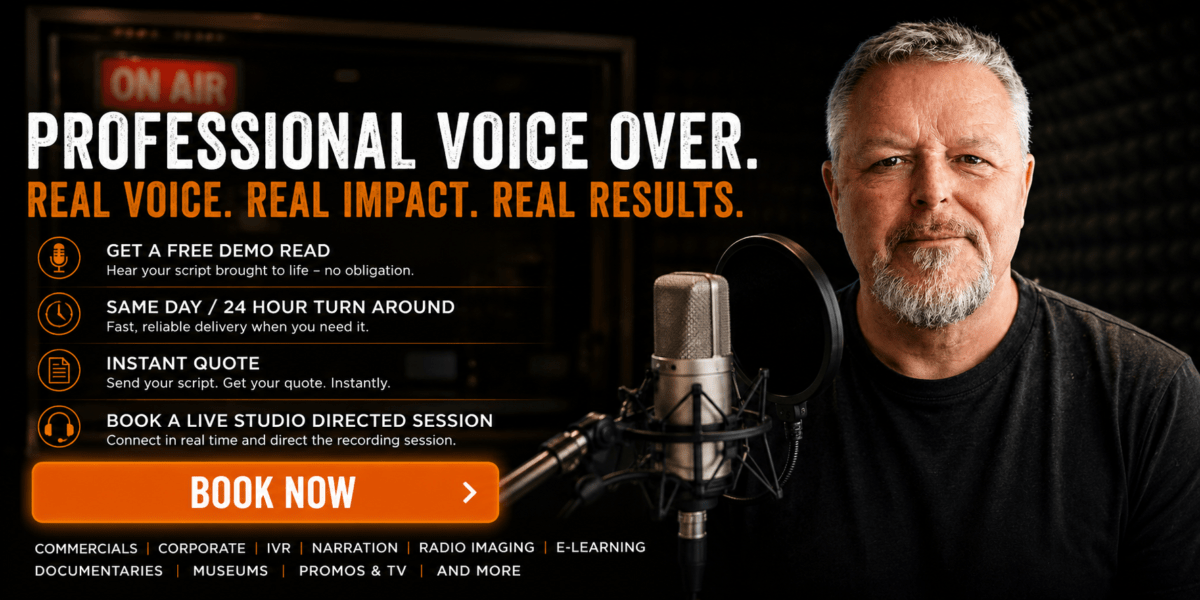
Professional British voice over artist Spencer Cork in a broadcast-quality recording studio with microphone and pop shield, offering free demo reads, instant quotes, same-day turnaround and live directed voice over sessions for commercials, corporate narration, IVR, radio imaging and e-learning projects.

Tell Me About Your Project

✔ Get a Free Demo Read – Absolutely No Obligation  ✔ Fast Response Times – Usually Within the Hour

✔ Same-Day Recording Available – 24-Hour Turnaround Standard

✔ Friendly, Professional Service from First Contact to Final Delivery

✔ Instant Quote – Send Your Script Today

Voice Over Quick Listens

More Samples on Commercial / Corporate / Documentary / Gaming and Characters / Podcast and Radio Pages

Conversational Voice Over

This conversational voice over demo demonstrates a natural, friendly and approachable delivery style. Perfect for explainer videos, online content and brand storytelling, this tone helps connect with your audience in an authentic way. If you need a British voice over artist who sounds real and relatable, this style is ideal for modern digital content.

Corporate Voice Over

This corporate voice over demo is designed for business presentations, company videos and professional communications. With a confident and authoritative tone, it’s ideal for corporate narration, internal training and promotional content. If you’re looking for a UK voice over artist for corporate voice over work, this style delivers clarity and professionalism.

Training and Learning

This is a professional British male voice over designed for e-learning, training courses and instructional content. Clear, engaging and easy to follow, this style is ideal for corporate training, online learning platforms and educational videos. If you’re looking for a reliable UK voice over artist for e-learning narration, this demo showcases a calm and professional delivery.

Radio and Television Commercials

This is a professional British voice over for radio and television commercials. Designed to capture attention and deliver your message clearly, this style works perfectly for advertising campaigns, brand promotions and broadcast media. If you’re looking to hire a UK voice over artist for commercial voice over work, this demo highlights a confident and engaging delivery.

Energetic and Upbeat

This energetic voice over demo showcases a lively, upbeat and engaging style, ideal for promotional videos, advertising campaigns and high-impact content. Perfect for brands that want to stand out, this British voice over delivers energy, clarity and enthusiasm. A great choice if you need a dynamic voice over artist for commercials or online marketing.

Characters and Gaming Voice Overs

A selection of Gaming and Character style voices showcasing a diverse range and ability for vocal delivery in the character and gaming video and onine market.

Movie Trailer and Voice of God VOG

Here is a demo reel for a dramatic cinematic style voice over delivery. Ideal for Movie Trailers and Promos and Voice of God Style VOG presentations or live events.

Narration in a Senior Voice Over Style

This narration is purposely in the style of a more senior person than myself, to showcase a diverse range of delivery styles. This is aimed at the senior 60+ age range.

Radio Station Voice Overs

 Bringing Radio Stations to Life with Radio Station Voice Over Idents, Promo's, Station Name and Presenter Name Drops.

Emotional Storytelling: Professional Voice Over That Creates Human Connection Through Story

Emotional storytelling is a professional voice-over delivery style that uses narrative interpretation, emotional authenticity, pacing, vocal dynamics and purposeful emphasis to help audiences connect with the people, experiences and meaning within a story. Emotional storytelling voice over is widely used in documentaries, charity films, brand stories, corporate films, human-interest productions, healthcare campaigns, personal stories, historical narratives and purpose-driven advertising. Unlike Emotional Voice, which describes an expressive vocal characteristic, Emotional Storytelling describes how a complete narrative is performed to create emotional connection while preserving the authenticity and meaning of the story.

What Is Emotional Storytelling?

Emotional Storytelling is the performance of a narrative in a way that helps an audience feel connected to its meaning.

The emotion does not come simply from making the voice sound emotional.

It comes from understanding:

  • Who the story is about
  • What has happened
  • Why it matters
  • What the characters or people have experienced
  • How the story develops
  • What the audience should understand or feel

Professional Emotional Storytelling Voice Over interprets the emotional journey of the script and allows the performance to develop naturally alongside it.

Some moments may require warmth.

Others may require restraint.

Some may require sadness, hope, tension, determination or joy.

The narrator's role is to serve the story rather than overwhelm it.

Emotional Storytelling is therefore an important professional Voice Delivery Style.

Explore the complete collection:

https://spencercork.co.uk/voice-delivery-styles/

What Defines Emotional Storytelling?

Professional Emotional Storytelling combines narrative understanding with authentic emotional interpretation.

Typical characteristics include:

  • Emotional authenticity
  • Narrative awareness
  • Controlled pacing
  • Dynamic vocal variation
  • Purposeful pauses
  • Subtle emphasis
  • Audience connection
  • Emotional progression

The performance should respond naturally to the changing emotional landscape of the story.

A powerful emotional performance does not require every sentence to sound intense.

Often, restraint creates greater impact.

Why Is Emotional Storytelling Important?

People frequently remember stories more strongly than isolated information.

Stories provide context.

They allow audiences to understand experiences through people, events and emotional journeys.

Professional Emotional Storytelling Voice Over can help audiences:

  • Connect with real experiences
  • Understand different perspectives
  • Feel empathy
  • Remember important messages
  • Recognise emotional significance
  • Engage with complex subjects
  • Follow a human journey

The voice becomes a bridge between the story and the listener.

Emotional Storytelling for Documentaries

Documentaries frequently contain stories with significant emotional depth.

Professional Emotional Storytelling can support:

  • Human-interest documentaries
  • Historical documentaries
  • Biographical films
  • Social documentaries
  • Nature productions
  • Current affairs
  • Personal testimony

The narrator must understand when to add emotional interpretation and when to allow the images, interviews or events to carry the emotion.

Over-performance can reduce authenticity.

Under-performance can make an important story feel disconnected.

The correct balance depends on the production.

Explore Documentary Narration:

https://spencercork.co.uk/documentary-narration/

Emotional Storytelling for Charity Films

Charity and nonprofit organisations often communicate through real human experiences.

Professional voice over can help tell stories involving:

  • Personal challenges
  • Community projects
  • Healthcare
  • Humanitarian work
  • Social change
  • Environmental issues
  • Fundraising campaigns

These stories require sensitivity.

The voice should respect the people represented rather than turning their experiences into exaggerated drama.

Authenticity is particularly important.

Emotional Storytelling for Brand Films

Brands increasingly communicate through stories rather than direct product promotion.

Professional Emotional Storytelling can support:

  • Brand origin stories
  • Customer experiences
  • Founder stories
  • Purpose-driven campaigns
  • Company heritage
  • Employee stories
  • Social impact films

The objective is to create emotional relevance around the organisation.

The story should remain central.

The brand becomes meaningful through its connection to that story.

Emotional Storytelling for Corporate Films

Corporate communication can also contain emotional narratives.

Professional voice over may support stories about:

  • Company history
  • Organisational change
  • Employee achievement
  • Innovation
  • Business transformation
  • Community impact
  • Company milestones

Emotional Storytelling can help transform corporate information into a human narrative.

Explore Corporate Voice:

https://spencercork.co.uk/corporate-voice/

Emotional Storytelling for Healthcare

Healthcare stories often involve deeply personal experiences.

Professional narration can support:

  • Patient stories
  • Healthcare campaigns
  • Medical charities
  • Research films
  • Public awareness campaigns
  • Hospital communications

The delivery should be empathetic without becoming intrusive.

A restrained performance often allows the story itself to create the emotional response.

Emotional Storytelling for Historical Narratives

History becomes more accessible when audiences understand the human experiences behind events.

Professional Emotional Storytelling can support:

  • Historical documentaries
  • Museum exhibits
  • Heritage attractions
  • Memorial projects
  • Biographical stories
  • Archive productions

The voice can help audiences connect emotionally with people and events from another time.

Emotional Storytelling for Advertising

Advertising sometimes uses narrative rather than direct sales messaging.

Professional Emotional Storytelling Voice Over can support:

  • Television commercials
  • Cinema advertising
  • Online campaigns
  • Brand films
  • Social media advertising
  • Purpose-led campaigns

The emotional connection may be created before the product or brand is introduced.

This approach can make the commercial message feel more human and memorable.

Explore Commercial Voice:

https://spencercork.co.uk/commercial-voice/

Emotional Storytelling for Social Media

Short-form storytelling can create strong emotional engagement.

Professional narration can support:

  • Human-interest stories
  • Mini-documentaries
  • Brand stories
  • Charity campaigns
  • Personal narratives
  • Historical content

The challenge is to establish emotional context quickly without forcing the performance.

The voice must still allow the story to develop naturally within a shorter format.

Emotional Storytelling Versus Emotional Voice

Emotional Storytelling and Emotional Voice are closely related but represent different concepts.

An Emotional Voice is a vocal characteristic capable of expressing or communicating emotion.

Emotional Storytelling is a delivery style that interprets the emotional journey of an entire narrative.

Emotional Voice describes what the voice can sound like.

Emotional Storytelling describes how emotion is used across a story.

Explore Emotional Voice:

https://spencercork.co.uk/emotional-voice/

Emotional Storytelling Versus Storytelling Voice

Storytelling Voice is a broader vocal style used to hold attention and guide audiences through stories.

Emotional Storytelling specifically focuses on the emotional meaning and progression of the narrative.

A story can be entertaining, informative, playful or dramatic without being primarily emotional.

Emotional Storytelling places human feeling and connection at the centre of the performance.

Explore Storytelling Voice:

https://spencercork.co.uk/storytelling-voice/

Emotional Storytelling Versus Narrative Voice

Narrative Voice provides structure and guides audiences through events, information or stories.

Emotional Storytelling adds emotional interpretation to that narrative journey.

Narrative Voice helps the audience follow the story.

Emotional Storytelling helps the audience feel its significance.

The two approaches frequently work together.

Explore Narrative Voice:

https://spencercork.co.uk/narrative-voice/

Emotional Storytelling Versus Dramatic Voice

A Dramatic Voice creates intensity, tension and theatrical impact.

Emotional Storytelling does not necessarily require dramatic delivery.

Some of the most emotionally powerful stories are performed with restraint.

A quiet pause or subtle change in tone may create greater emotional impact than an overtly dramatic performance.

Explore Dramatic Voice:

https://spencercork.co.uk/dramatic-voice/

Emotional Storytelling Versus Motivational Voice

Motivational Voice encourages confidence, determination and action.

Emotional Storytelling creates connection with the emotional journey of a narrative.

A story may ultimately become motivational, but motivation is not necessarily its primary purpose.

For example, a documentary may tell the emotional story of someone overcoming adversity.

The story creates emotional connection.

Its conclusion may then become motivational.

Explore Motivational Voice:

https://spencercork.co.uk/motivational-voice/

Different Emotional Storytelling Styles

Emotional Storytelling can incorporate many different vocal characteristics.

Depending on the narrative, the voice may be:

  • Emotional
  • Authentic
  • Warm
  • Expressive
  • Dramatic
  • Serious
  • Reassuring
  • Inspirational
  • Conversational
  • Powerful

A personal story may require intimate and authentic delivery.

A historical story may require serious and reflective narration.

A brand film may build towards an inspirational conclusion.

A documentary may move through several emotional characteristics within the same production.

This demonstrates the relationship between Voice Characteristics and Voice Delivery Styles.

Voice characteristics describe what the voice sounds like at a particular moment.

Voice delivery styles describe how the complete script is performed to achieve its communication objective.

The Importance of Emotional Authenticity

Audiences quickly recognise when emotion feels forced.

Professional Emotional Storytelling requires the voice artist to understand the emotional context rather than simply imitate an emotional sound.

Authentic delivery may involve:

  • Natural phrasing
  • Subtle vocal changes
  • Controlled breathing
  • Purposeful pauses
  • Changes in pace
  • Changes in intensity
  • Vocal restraint

The objective is to respond truthfully to the meaning of the script.

The Importance of Restraint

Emotional storytelling often becomes more powerful when the narrator does less.

If the script, music and visuals already carry significant emotion, an overly emotional voice can compete with them.

Professional narration considers the complete production.

Sometimes the strongest delivery is quiet, simple and controlled.

The audience should be allowed space to experience the emotion themselves.

Building an Emotional Journey

Many stories contain an emotional progression.

A narrative may move through:

Introduction

The audience meets the person, place or situation.

Connection

The story establishes why the subject matters.

Challenge

Conflict, difficulty or uncertainty develops.

Change

Something shifts within the narrative.

Resolution

The audience understands the outcome.

Reflection

The story reveals its wider meaning.

Professional Emotional Storytelling adapts the delivery throughout this journey.

The voice should evolve with the story.

The Importance of Pauses

Silence can be part of the performance.

Purposeful pauses can:

  • Allow emotional moments to settle
  • Give audiences time to reflect
  • Create anticipation
  • Separate significant ideas
  • Increase intimacy
  • Support visual storytelling

Professional Emotional Storytelling understands when not to speak as much as when to emphasise a line.

Emotional Storytelling and Music

Music frequently plays an important role in emotional productions.

The voice and music should work together.

A professional voice performance should leave space for:

  • Musical builds
  • Emotional transitions
  • Visual sequences
  • Significant pauses
  • Final resolutions

This requires controlled pacing and an awareness of how the narration may sit within the finished production.

Choosing the Right Emotional Storytelling Voice

The appropriate delivery depends on the story.

Clients should consider:

  • Who the story is about
  • The emotional journey
  • Audience expectations
  • Subject sensitivity
  • Production style
  • Music and visuals
  • Desired emotional response
  • Brand or organisational context

The narrator should serve the story rather than impose a predetermined emotional style upon it.

Recording Professional Emotional Storytelling Voice Over

Emotional performances often rely on subtle vocal details.

A broadcast-quality recording environment helps capture:

  • Natural breath
  • Vocal texture
  • Subtle changes in tone
  • Controlled dynamics
  • Quiet delivery
  • Emotional variation

Clean professional audio allows intimate performances to retain their impact.

Explore Related Voice Characteristics

Emotional Storytelling can incorporate many voice characteristics from the Spencer Cork Voice Over Knowledge Hub.

Related styles include:

Emotional Voice
https://spencercork.co.uk/emotional-voice/

Authentic Voice
https://spencercork.co.uk/authentic-voice/

Warm Voice
https://spencercork.co.uk/warm-voice/

Expressive Voice
https://spencercork.co.uk/expressive-voice/

Dramatic Voice
https://spencercork.co.uk/dramatic-voice/

Serious Voice
https://spencercork.co.uk/serious-voice/

Inspirational Voice
https://spencercork.co.uk/inspirational-voice/

Conversational Voice
https://spencercork.co.uk/conversational-voice/

Powerful Voice
https://spencercork.co.uk/powerful-voice/

Soft and Calm Voice
https://spencercork.co.uk/soft-and-calm-voice/

Emotional Storytelling Compared with Other Delivery Styles

Delivery Style Primary Purpose
Emotional Storytelling Create emotional connection through a narrative journey
Narrative Voice Guide audiences through structured stories or information
Motivational Voice Encourage confidence, determination and action
Reassuring Voice Reduce uncertainty and build confidence
Informative Voice Communicate facts and useful information clearly
Persuasive Voice Influence attitudes, preferences or behaviour
Promotional Voice Generate attention and interest

Several delivery styles can appear within the same production, but Emotional Storytelling is defined by its focus on the emotional journey and meaning of the narrative.

Frequently Asked Questions

What is Emotional Storytelling Voice Over?

Emotional Storytelling Voice Over is a professional delivery style that uses narrative interpretation, emotional authenticity, pacing and vocal dynamics to help audiences connect with the people, experiences and meaning within a story.

Where is Emotional Storytelling used?

Emotional Storytelling is widely used in documentaries, charity films, brand stories, corporate films, healthcare campaigns, historical narratives, human-interest productions and purpose-driven advertising.

Is Emotional Storytelling the same as Emotional Voice?

No. Emotional Voice describes a vocal characteristic capable of expressing emotion, while Emotional Storytelling describes how emotion is interpreted and developed across an entire narrative.

Does Emotional Storytelling need to sound dramatic?

No. Emotional Storytelling can be quiet, restrained and subtle. In many productions, understated delivery creates a stronger emotional response than overtly dramatic performance.

What makes good Emotional Storytelling?

Good Emotional Storytelling combines authentic script interpretation, narrative awareness, controlled pacing, appropriate vocal dynamics, purposeful pauses and sufficient restraint to allow the audience to experience the story naturally.

Why Work with Spencer Cork for Emotional Storytelling Voice Over?

With decades of professional broadcasting and voice-over experience, Spencer Cork provides Emotional Storytelling Voice Over for productions requiring authentic narrative interpretation, emotional connection and professional audio quality.

Professional broadcasting experience provides a strong understanding of storytelling, pacing and audience engagement, while voice-over experience allows emotional scripts to be performed with control and sensitivity.

From a broadcast-quality professional recording studio, Emotional Storytelling Voice Over can be produced for documentaries, brand films, charity campaigns, corporate productions, healthcare communications, historical narratives and digital content.

Conclusion

Emotional Storytelling is a professional Voice Delivery Style designed to create human connection through the emotional interpretation of a narrative.

Unlike Emotional Voice, which describes a vocal characteristic, Emotional Storytelling describes how emotion develops across an entire story and how the narrator responds to that journey.

Through authentic interpretation, controlled pacing, vocal dynamics, purposeful pauses and restraint, professional Emotional Storytelling Voice Over helps audiences connect with the people, experiences and meaning behind a story.

As part of the Voice Delivery Styles knowledge hub, Emotional Storytelling establishes strong semantic relationships with Narrative Voice, Motivational Voice, Reassuring Voice and Persuasive Voice, while connecting naturally with existing entities including Emotional Voice, Storytelling Voice, Authentic Voice, Expressive Voice, Dramatic Voice and Inspirational Voice.

➡️ https://spencercork.co.uk/

voiceover cta small Get a FAST Quote Today !

Table of Contents for Voice Over Artist UK