The Science of Listening
Tell Me About Your Project
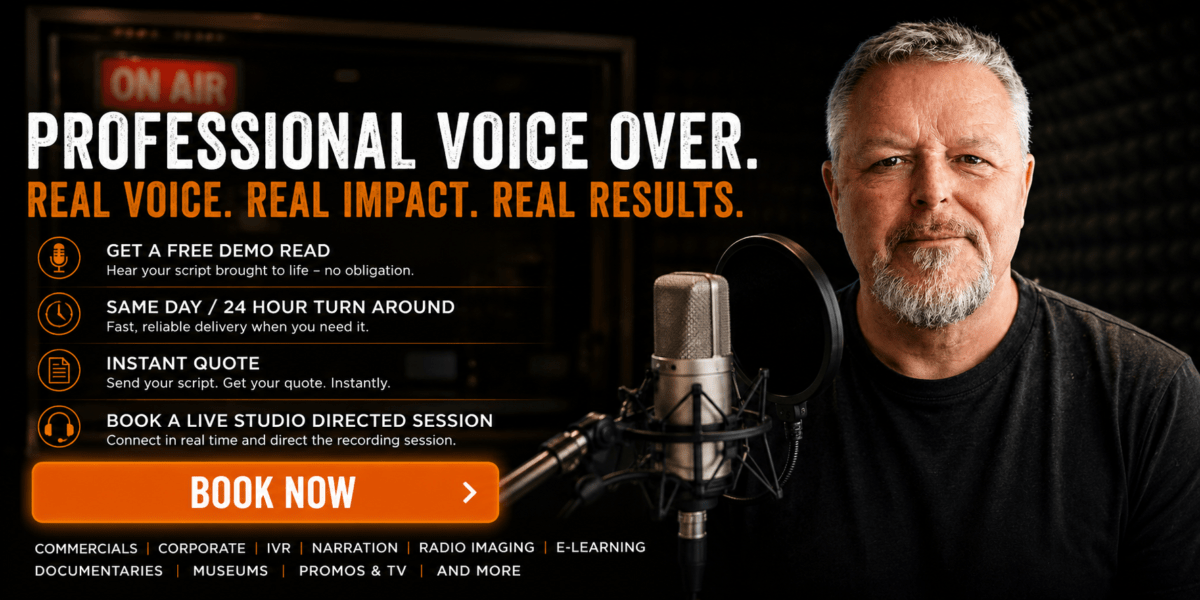
✔ Get a Free Demo Read – Absolutely No Obligation ✔ Fast Response Times – Usually Within the Hour
✔ Same-Day Recording Available – 24-Hour Turnaround Standard
✔ Friendly, Professional Service from First Contact to Final Delivery
✔ Instant Quote – Send Your Script Today
Voice Over Quick Listens
More Samples on Commercial / Corporate / Documentary / Gaming and Characters / Podcast and Radio Pages
Conversational Voice Over
This conversational voice over demo demonstrates a natural, friendly and approachable delivery style. Perfect for explainer videos, online content and brand storytelling, this tone helps connect with your audience in an authentic way. If you need a British voice over artist who sounds real and relatable, this style is ideal for modern digital content.
Corporate Voice Over
This corporate voice over demo is designed for business presentations, company videos and professional communications. With a confident and authoritative tone, it’s ideal for corporate narration, internal training and promotional content. If you’re looking for a UK voice over artist for corporate voice over work, this style delivers clarity and professionalism.
Training and Learning
This is a professional British male voice over designed for e-learning, training courses and instructional content. Clear, engaging and easy to follow, this style is ideal for corporate training, online learning platforms and educational videos. If you’re looking for a reliable UK voice over artist for e-learning narration, this demo showcases a calm and professional delivery.
Radio and Television Commercials
This is a professional British voice over for radio and television commercials. Designed to capture attention and deliver your message clearly, this style works perfectly for advertising campaigns, brand promotions and broadcast media. If you’re looking to hire a UK voice over artist for commercial voice over work, this demo highlights a confident and engaging delivery.
Energetic and Upbeat
This energetic voice over demo showcases a lively, upbeat and engaging style, ideal for promotional videos, advertising campaigns and high-impact content. Perfect for brands that want to stand out, this British voice over delivers energy, clarity and enthusiasm. A great choice if you need a dynamic voice over artist for commercials or online marketing.
Characters and Gaming Voice Overs
A selection of Gaming and Character style voices showcasing a diverse range and ability for vocal delivery in the character and gaming video and onine market.
Movie Trailer and Voice of God VOG
Here is a demo reel for a dramatic cinematic style voice over delivery. Ideal for Movie Trailers and Promos and Voice of God Style VOG presentations or live events.
Narration in a Senior Voice Over Style
This narration is purposely in the style of a more senior person than myself, to showcase a diverse range of delivery styles. This is aimed at the senior 60+ age range.
Radio Station Voice Overs
Bringing Radio Stations to Life with Radio Station Voice Over Idents, Promo's, Station Name and Presenter Name Drops.
The Science of Listening
Listening is an active cognitive process that extends far beyond simply hearing sounds. While hearing is the physiological ability to detect sound, listening involves attention, interpretation, memory, language processing and decision-making. The brain continuously filters, prioritises and interprets incoming auditory information, allowing people to understand speech, recognise emotion, focus on important sounds and ignore distractions. The science of listening explores how auditory attention, cognition and perception work together to transform sound into meaningful communication. Research shows that listening depends on complex interactions between hearing, attention and higher cognitive processes.
Introduction
People often use the words hearing and listening interchangeably, but they describe two very different processes.
Hearing is automatic. Every waking moment, our ears detect thousands of sounds from conversations, traffic, birdsong, music, air conditioning, keyboards and countless other sources.
Listening is different.
Listening requires the brain to decide which sounds deserve attention, what those sounds mean and how they should influence our thoughts or actions. It is an active process rather than a passive one.
Imagine sitting in a busy café while speaking with a friend. Around you are dozens of conversations, coffee machines, background music and people walking past. Yet somehow your brain allows you to focus on a single voice while reducing the importance of everything else.
This remarkable ability illustrates one of the most sophisticated functions of human cognition.
Understanding the science of listening helps explain why professional voice over is so effective. Successful communication depends not only upon producing clear speech but also upon how listeners process, interpret and remember what they hear.
Hearing Is Not Listening
The ears collect sound.
The brain creates meaning.
This distinction is fundamental to communication.
Hearing involves detecting sound waves.
Listening involves:
- attention
- interpretation
- language processing
- memory
- emotional recognition
- decision making
- understanding
- response
Psychologists often describe listening as the point where hearing becomes cognition because it transforms sound into meaningful information.
Attention Determines What We Hear
Every environment contains more sound than the brain can process simultaneously.
To avoid overload, the brain constantly selects the information that appears most important.
This process is known as auditory attention.
It helps people:
- focus on conversations
- ignore background noise
- detect important warnings
- recognise familiar voices
- follow spoken instructions
- understand speech
- process language
- maintain concentration
Without auditory attention, everyday communication would become extremely difficult.
The Brain Filters Competing Sounds
One of the most impressive features of listening is the brain's ability to separate meaningful sounds from background noise.
Examples include:
- following one conversation in a crowded room
- hearing your own name across a busy office
- recognising a family member's voice
- identifying emergency alarms
- concentrating during meetings
- listening to educational material
- understanding podcasts while travelling
- following narration in documentaries
This selective filtering allows communication to remain effective even in complex listening environments.
Listening Depends Upon Memory
Listening is closely connected to memory.
As people hear spoken information, the brain temporarily stores sounds while interpreting their meaning.
This process allows listeners to:
- understand complete sentences
- recognise patterns
- connect ideas
- remember instructions
- follow stories
- interpret conversations
- learn new concepts
- recall important information
Without short-term auditory memory, conversation would become fragmented because earlier words would disappear before later words were processed.
Emotion Influences Listening
People do not listen only to words.
They also listen for emotional meaning.
The brain continuously evaluates:
- confidence
- empathy
- warmth
- concern
- enthusiasm
- sincerity
- reassurance
- authority
These emotional signals help listeners understand the speaker's intentions while strengthening communication.
Professional voice over relies heavily upon this natural psychological process.
Listening Requires Mental Effort
Although listening often feels effortless, it requires significant cognitive resources.
The brain must simultaneously:
- decode speech
- recognise vocabulary
- interpret grammar
- identify emotion
- maintain attention
- ignore distractions
- update memory
- prepare responses
As background noise increases or speech becomes less clear, listening demands greater mental effort.
Good Listening Improves Learning
Learning depends heavily upon effective listening.
When spoken communication is clear and well structured, learners often experience:
- better comprehension
- stronger concentration
- improved memory
- greater engagement
- reduced confusion
- higher confidence
- improved retention
- easier recall
This explains why professional narration plays such an important role in education, workplace training and instructional media.
Listening Strengthens Relationships
Listening is central to human relationships.
People who feel genuinely listened to often report stronger feelings of:
- trust
- respect
- empathy
- understanding
- connection
- cooperation
- confidence
- belonging
High-quality listening benefits both speakers and listeners by encouraging more positive and meaningful communication.
Why Professional Voice Over Supports Better Listening
Professional voice over is designed to work with the brain's natural listening processes.
Effective narration uses:
- clear pronunciation
- natural pacing
- vocal variety
- strategic pauses
- conversational rhythm
- expressive delivery
- logical structure
- consistent tone
These qualities help listeners focus their attention while reducing unnecessary mental effort.
Rather than competing for attention, professional narration guides it.
Human Voice and Artificial Intelligence
Artificial intelligence continues to improve speech generation and voice synthesis.
However, successful listening depends on much more than intelligible speech.
Listeners naturally respond to qualities such as:
- authenticity
- emotional expression
- conversational timing
- empathy
- subtle vocal variation
- confidence
- personality
- human connection
These characteristics help maintain attention and improve understanding throughout longer listening experiences.
The Future of Listening
As communication becomes increasingly digital, listening is becoming more important than ever.
Podcasts, online learning, audiobooks, virtual meetings, streaming media, voice assistants and spoken interfaces all depend upon effective listening rather than simply hearing.
Understanding how the brain processes spoken communication will continue to shape education, healthcare, accessibility, marketing and professional communication.
Professional voice over supports this future by presenting information in ways that align with how people naturally listen, understand and remember.
Key Takeaways
- Hearing and listening are different cognitive processes.
- Listening requires attention, interpretation and memory.
- The brain selectively focuses on important sounds while filtering distractions.
- Emotion plays an important role in how spoken communication is interpreted.
- Effective listening improves learning, relationships and decision making.
- Professional voice over supports natural listening by combining clarity, structure and expressive delivery.
If you are searching for a reliable UK voice talent who can deliver professional recordings quickly and consistently, explore the full range of services here:
➡️ https://spencercork.co.uk/
 Get a FAST Quote Today !